How to identify a common wasp
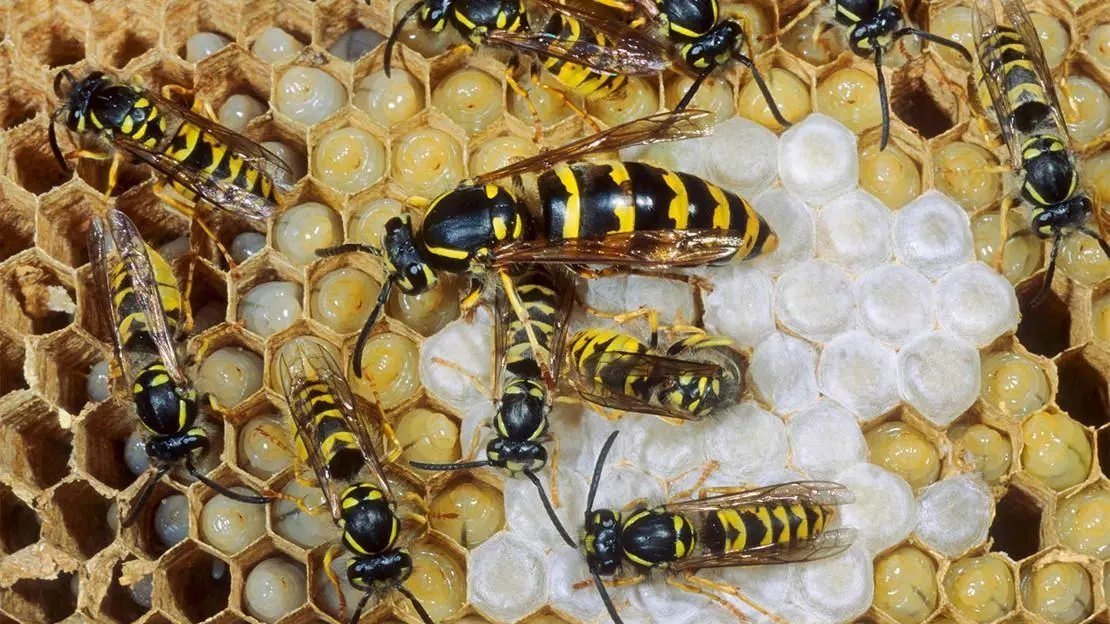
- Workers 12–17 mm, queens up to 20 mm, with bright yellow and black bands on the abdomen.
- Smooth, shiny body with very little hair and a sharply pinched waist.
- A black anchor-shaped mark on the yellow face; the similar German wasp usually shows one to three black dots instead.
- Wings fold lengthways along the body at rest, so they look narrow.
- Yellow legs and long black antennae.
- The nest is chewed wood pulp, grey-beige with a scalloped, shell-like pattern and a single entrance hole.
What it's often confused with
| Look-alike | How to tell them apart |
|---|---|
| Honeybee | Golden-brown and furry rather than bright yellow and shiny, with a thicker waist; a honeybee can only sting once and should not be killed. |
| Hoverfly | Yellow and black but with one pair of wings, huge eyes covering most of the head and short stubby antennae; it hovers in one spot and cannot sting. |
| European hornet | Much larger at 25–35 mm and brown-and-yellow rather than black-and-yellow; it is native, nests in hollow trees and sheds, and is usually calmer than a common wasp. |
| Yellow-legged (Asian) hornet | A dark brown-black body with one orange band near the tail and bright yellow legs; it is invasive and any sighting should be reported through the Asian Hornet Watch app. |
| Tree bumblebee | Ginger thorax, black abdomen and white tail, very hairy; it nests in bird boxes and roof fascias in early summer, and the colony dies off within weeks. |
Signs of common wasps
- Wasp traffic
- A steady stream of wasps flying in and out of one hole in a wall, soffit, roof tile, bank or hedge.
- The nest
- A grey papery ball, golf-ball sized in spring and football-sized or larger by late summer.
- Scraped wood
- Fine pale scratch lines on fences, sheds and garden furniture where workers strip wood fibres for building.
- Wasps indoors
- Wasps appearing in bedrooms or on the landing, sometimes chewing through ceiling plasterboard from a nest above.
- Crackling noise
- A papery rustling or scratching from a wall cavity or loft as the colony chews and builds.
- Dead wasps
- Sluggish or dead wasps on windowsills in late summer and autumn.
Where it lives and how it behaves
A single queen, who has spent the winter hibernating in a shed, loft or log pile, starts a nest on her own in April or May. She raises the first batch of workers, then stays inside laying eggs while they build and forage. By late summer a nest can hold several thousand workers. All summer the workers hunt caterpillars and flies to feed the larvae, and the larvae give them a sugary liquid in return. In late summer the larvae run out, so workers turn to fruit, drinks and bins, which is when they become a nuisance. New queens and males leave in autumn, the old queen dies, and the nest is never used again.
Health and property risks
Wasps can sting repeatedly, and a disturbed nest releases an alarm scent that sends more wasps out to defend it. Most stings mean a few hours of pain and swelling. Some people react more severely: a fast-spreading rash, swelling of the lips or throat, dizziness or difficulty breathing after a sting is anaphylaxis and needs a 999 call. Anyone with a known sting allergy should stay well away from a nest. Nests in lofts can also damage ceilings when wasps chew through plasterboard.
What UK law says
Common wasps have no legal protection in the UK, and a nest on your property can be treated. Any insecticide used must be approved for the job and applied as its label says; that is a legal requirement, not advice. Bees are a different matter. Honeybee swarms should go to a volunteer swarm collector through the British Beekeepers Association, and a suspected yellow-legged hornet should be reported to the authorities, not tackled yourself.
Can you deal with it yourself?
A small nest at ground level or in a shed, found early in summer, can be dealt with using shop-bought wasp powder puffed into the entrance at dusk, when the workers are home. Do not block the entrance, pour petrol or water in, or try to knock the nest down. Call someone for nests in lofts, wall cavities, under roof tiles or anywhere you would need a ladder, and for any nest if someone in the house has a sting allergy. A nest found in October or November can often be left: the colony is dying and the nest will not be reused.
How Pest Perfection treats it
We confirm it is a wasp nest and not bees, then apply an insecticidal dust or spray into the nest or its entrance. Wasps passing through carry it deeper into the nest. Activity usually drops within hours and the colony is normally dead within a day or two. Expect returning wasps around the entrance on the first afternoon, and do not block the hole: they need to go in to pick up the treatment. The nest does not have to be removed for the treatment to work, and a dead nest in a loft does no harm. Wasp nest treatment starts from £90.
Free inspection · from £90 · guaranteed for at least three months
Call 01727 400025How to prevent it
- 1Check sheds, eaves, lofts and bird boxes in April and May, when a new nest is golf-ball sized and easy to spot.
- 2Fill gaps in soffits, fascia boards and around roof tiles before spring.
- 3Keep bin lids shut and rinse cans and bottles before they go in the recycling in late summer.
- 4Pick up windfall apples and plums, which draw wasps in large numbers in August and September.
- 5Fit fly screens to kitchen and bedroom windows if there is a nest nearby.
- 6Cover drinks and food outdoors in late summer, and look inside a can before drinking from it.
What we see on our jobs
Hertfordshire's mix of suburban gardens, orchards, farmland edges and woodland suits common wasps, and nests in lofts, under roof tiles and in the eaves of Victorian and interwar houses turn up every summer from June. Dry banks along the Ver and Lea valleys and loose soil at the edges of lawns are typical sites for underground nests. European hornets also nest in the county's woodland, old trees and sheds.
Areas we cover: St Albans · Harpenden · Hatfield · Welwyn Garden City · Watford · all areas
Common wasp: questions
Will wasps come back to the same nest next year?
No. A wasp nest is used for one season only. The old queen dies in autumn and the new queens hibernate elsewhere. A new nest can still be built nearby if the site suits them, so fill gaps over winter.
Can I leave a wasp nest alone?
Often, yes, if it is away from doors, paths and play areas and nobody in the house is allergic. Wasps also eat garden pests. If the nest is by an entrance, in a loft over a bedroom or growing into a ceiling, treating it is safer.
Is it a wasp or a bee?
Wasps are shiny, bright yellow and black with a narrow waist and little hair. Honeybees are brown and furry; bumblebees are round and very hairy. If they are bees, leave them or contact a beekeeper. Honeybees should not be killed.
What should I do if I'm stung by a wasp?
Move away from the nest, wash the area with soap and water, and hold something cold on it for at least 10 minutes. Wasps do not leave a sting behind. Call 999 if swelling reaches the lips or throat, or the person struggles to breathe or feels faint.
Why are wasps so aggressive in September?
The colony has stopped raising larvae, so workers lose their sugar supply and hunt for it in fruit, drinks and bins. The nest is also at its largest, with more wasps to defend it.