How to identify a German cockroach
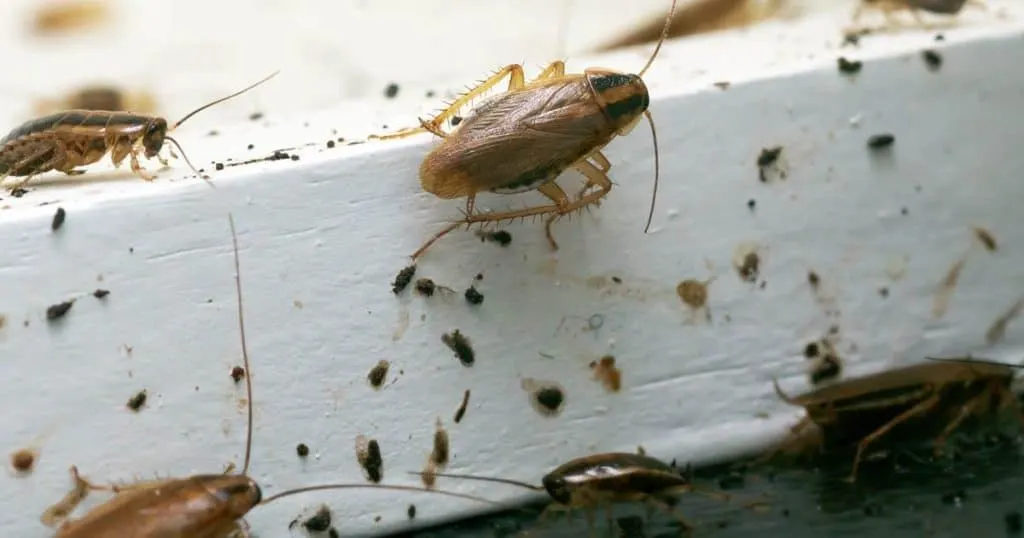
- Adults 10–15 mm, slim and flat, light tan to yellowish-brown.
- Two dark stripes running lengthways on the pronotum, the shield-like plate behind the head.
- Wings cover the whole body in adults of both sexes, but they rarely fly.
- Long, fine antennae, often as long as the body.
- Females carry a light-brown egg case (ootheca) sticking out from the tail end until the eggs are close to hatching.
- Nymphs are darker, wingless and have a pale stripe down the middle of the back.
What it's often confused with
| Look-alike | How to tell them apart |
|---|---|
| Oriental cockroach | Larger at 20–24 mm, shiny dark brown to black and slow-moving; males have short wings, females only wing stubs, and it lives in cooler, damp places such as drains, cellars and ground floors. |
| Brown-banded cockroach | Similar in size but with two pale bands across the wings or body; it is rare in the UK and prefers warm, dry spots higher up in a room. |
| American cockroach | Much bigger at around 35–40 mm and reddish-brown; in the UK it is mostly confined to heated ducts, sewers and large buildings. |
| Ground beetles | Hard wing cases that meet in a straight line down the back and shorter antennae; they wander in from the garden and do not breed indoors. |
Signs of German cockroaches
- Live cockroaches
- Seen scattering at night when a light goes on; one seen in daylight often means hiding places are full.
- Droppings
- German droppings are tiny dark specks like ground pepper; oriental droppings are larger and cylindrical.
- Egg cases
- Light brown, purse-shaped and about 8 mm long for German cockroaches; oriental egg cases are darker and larger.
- Cast skins
- Pale, empty nymph skins behind appliances, in cupboard hinges and under sinks.
- Smear marks
- Dark, irregular brown marks on surfaces where they gather in humid places.
- Smell
- An oily, musty odour in heavy infestations.
Where it lives and how it behaves
German cockroaches need warmth, moisture and food, and a modern kitchen supplies all three. They hide in cracks during the day, often in groups, in the motor housings of fridges and dishwashers, behind splashbacks, in cupboard hinges, under sinks and inside electrical equipment. Each egg case holds 30 or more eggs, and in warm conditions a population multiplies quickly. They climb smooth surfaces easily, move between flats through service ducts, pipe runs and shared walls, and arrive in homes in second-hand appliances, deliveries and food packaging. They cannot survive long outdoors in a British winter.
Health and property risks
Cockroaches walk through drains, bins and food, carrying bacteria such as salmonella and E. coli on their legs and bodies. Their droppings, cast skins and saliva contain allergens that can trigger asthma and skin reactions, especially in children. Treat any food or surface they have walked over as contaminated. For a food business, cockroaches are one of the quickest routes to a failed inspection or a closure notice from environmental health.
What UK law says
No law protects cockroaches. Food businesses must keep premises free of pests under food hygiene law, and environmental health officers can close a kitchen until an infestation is under control. In rented homes and blocks of flats, councils can assess pests as a hazard under the Housing Health and Safety Rating System, and a block-wide problem usually has to be tackled by the landlord or managing agent, because treating one flat on its own rarely works.
Can you deal with it yourself?
Gel baits sold for home use can knock back a small, recently arrived German cockroach population if you place small dots in the cracks where they hide and keep the kitchen scrupulously clean. Avoid sprays and foggers: they scatter cockroaches into walls and neighbouring flats and make baits less attractive. If you see cockroaches in daylight, find them in more than one room, live in a block of flats or run a food business, get help. Oriental cockroaches coming up from a drain need the drain fixing as well.
How Pest Perfection treats it
Identification comes first, because German and oriental cockroaches live in different places and need different approaches. We inspect with a torch and set sticky monitoring traps to find where the population is concentrated. Treatment is usually gel bait placed in cracks and hinges, with insecticides approved for cockroach control and, where needed, an insect growth regulator that stops nymphs maturing. Egg cases shield the eggs from most treatments, so follow-up visits over several weeks are part of the job. We advise on cleaning, clutter and gaps around pipes, and keep a written record of each visit. Treatment starts from £90.
Free inspection · from £90 · guaranteed for at least three months
Call 01727 400025How to prevent it
- 1Check second-hand fridges, cookers and microwaves before they come into the house, especially around motors and door seals.
- 2Wipe worktops and sweep under appliances every night; a few crumbs will keep a colony going.
- 3Fix dripping taps and leaks under sinks, because cockroaches need a regular supply of water.
- 4Seal gaps where pipes pass through walls and behind kitchen units.
- 5Store food in sealed containers and don't leave pet food out overnight.
- 6Keep drain covers and sink traps in good repair to keep oriental cockroaches out.
What we see on our jobs
In Hertfordshire, German cockroaches are mainly a problem in heated buildings with shared services: blocks of flats in Watford, Stevenage, Hatfield and Hemel Hempstead, takeaway and restaurant kitchens, and care homes. Oriental cockroaches turn up more in older properties with cellars, old drains and ground-floor kitchens, including Victorian terraces around St Albans. Both arrive in deliveries and second-hand appliances.
Areas we cover: St Albans · Harpenden · Hatfield · Welwyn Garden City · Watford · all areas
German cockroach: questions
What is the difference between German and oriental cockroaches?
German cockroaches are 10–15 mm, light brown with two dark stripes behind the head, and live in warm kitchens and appliances. Oriental cockroaches are 20–24 mm, shiny black or dark brown, and live in cooler, damp places such as drains and cellars.
Do cockroaches mean my kitchen is dirty?
Not necessarily. German cockroaches often arrive in packaging or appliances, or from a neighbouring flat. Poor cleaning does help them multiply, so cleaning is part of any treatment.
Can cockroaches fly?
German cockroaches have full wings but rarely fly; they run instead. Oriental cockroaches cannot fly at all. A cockroach you see in a UK home will almost always be running, not flying.
How long does it take to get rid of cockroaches?
Expect several weeks and more than one visit. Baits work over days, and egg cases hatch after the first treatment, so follow-up visits are needed to catch the next generation.
Why do I only see cockroaches at night?
They avoid light and come out to feed when the kitchen is dark and quiet. Seeing them in daylight usually means their hiding places are full, which points to a larger infestation.