How to identify a brown rat
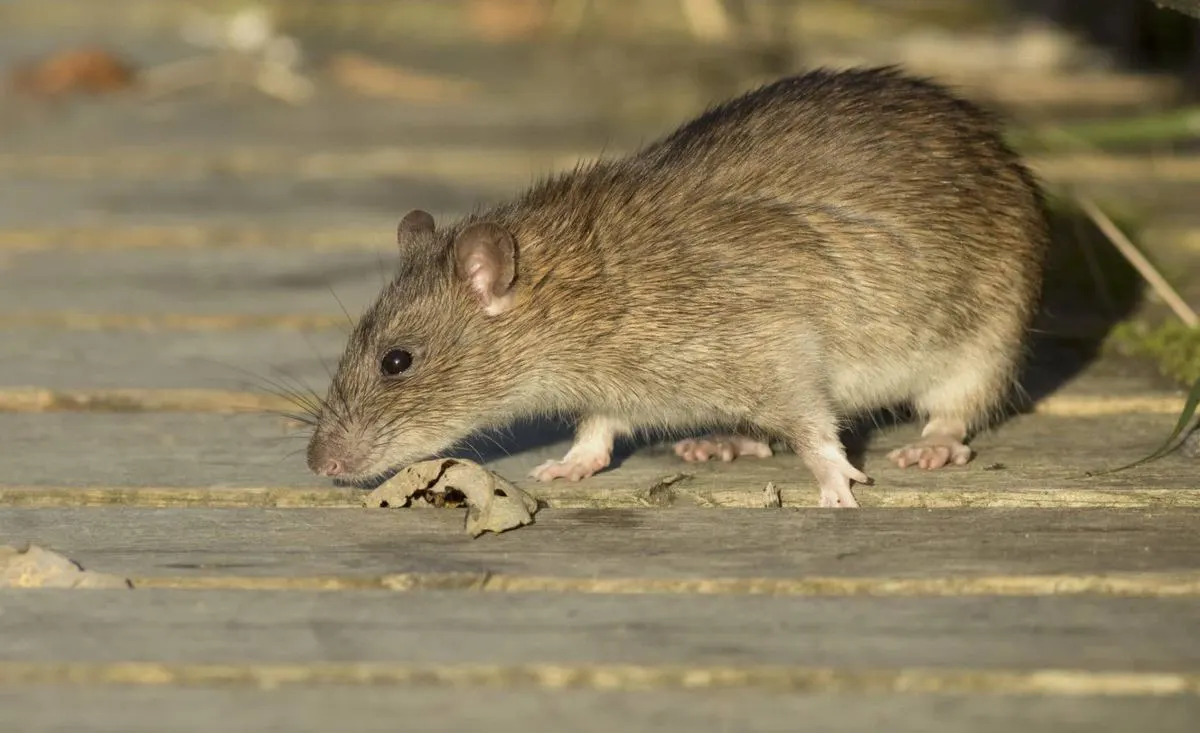
- Head and body 20–27 cm, tail 17–23 cm, and adults usually weigh 200–500 g: several times heavier than any mouse.
- Blunt, rounded snout and small, finely haired ears that do not reach the eyes when folded forward.
- Coarse grey-brown fur on the back, fading to pale grey or off-white underneath.
- Thick, scaly tail, darker on top than underneath and shorter than the head and body combined.
- Young rats have oversized heads and feet for their bodies and are often mistaken for large mice.
- Runs along walls, fence bases and pipes on the same routes every night, mostly between dusk and dawn.
What it's often confused with
| Look-alike | How to tell them apart |
|---|---|
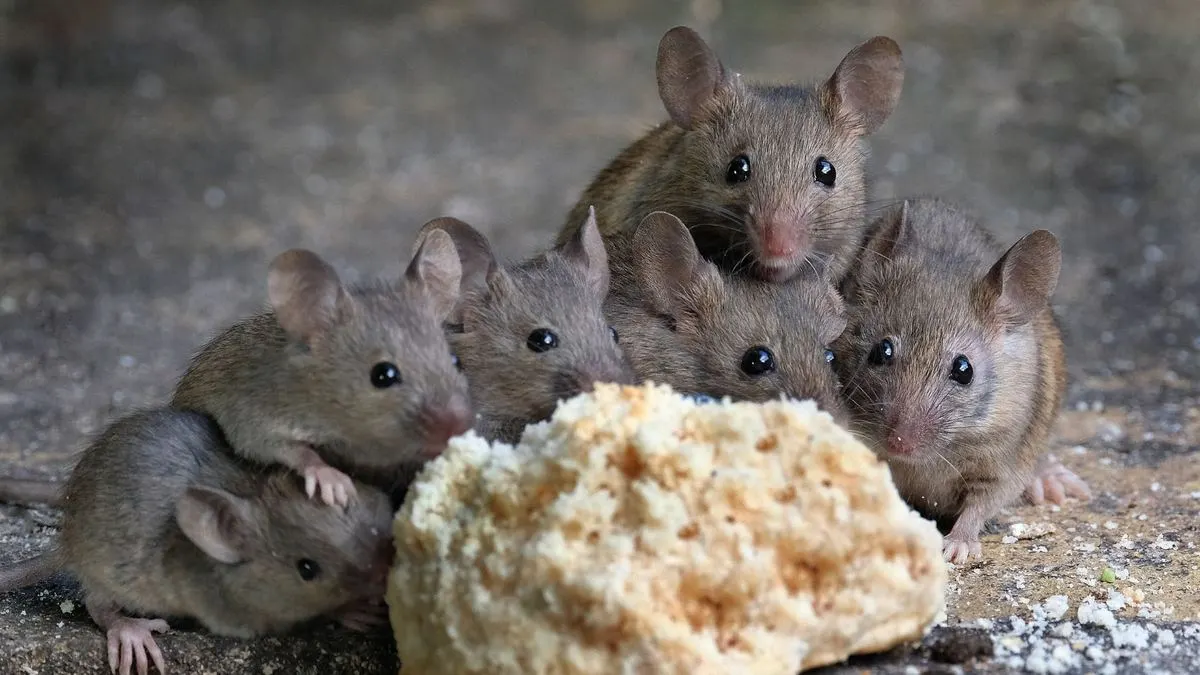
| House mouse | A mouse is 7–9.5 cm long with large ears and a tail as long as its body, and its droppings are a third of the length of a rat's. |
| Black (ship) rat | Now almost absent from Britain outside a few port areas, it has a pointed face, large thin ears and a tail longer than its body. |
| Water vole | Found on river banks such as the Ver and Colne, it has a round face, tiny ears hidden in fur and a short furry tail, and it is protected by law. |
| Grey squirrel | A squirrel has a bushy tail and is active in daylight, whereas a rat running along a fence top shows a bare, scaly tail. |
Signs of brown rats
- Droppings
- Dark, capsule-shaped, 10–14 mm long, usually in small clusters along runs or near food.
- Runs and smear marks
- Flattened tracks through grass, and dark greasy rub marks on skirting, joists and pipes where fur brushes the surface.
- Burrows
- Holes 6–9 cm across with smooth, packed entrances under decking, sheds, compost bins or at the base of walls.
- Gnawing
- Paired tooth marks on wood, plastic pipe and cable sheathing. Fresh gnawing is pale; old gnawing darkens.
- Noises
- Scratching and heavier scurrying at night in ceilings, under floors or behind kitchen units.
- Smell and footprints
- A sharp ammonia smell in enclosed spaces; footprints and tail-drag lines in dust or mud.
Where it lives and how it behaves
Brown rats live in family groups and dig burrows in soft ground, under decking and sheds, and along banks. In towns many live in the sewers and reach houses through broken or disused drain pipes, which is why a rat can turn up in a kitchen with no hole in any outside wall. They are wary of anything new, so a trap or bait box can be ignored for several days. A female can breed from about three months old, has litters of six to eleven after a three-week pregnancy and can raise five litters a year. They eat almost anything: bird seed, compost, pet food and bin waste.
Health and property risks
Rat urine can carry the bacteria that cause leptospirosis, including its severe form, Weil's disease. It is uncommon in the UK, but people who work around water, sewers or farms, or who clear up after rats without gloves, carry the most risk. Rats also spread salmonella and other gut bacteria onto worktops and food. Their teeth never stop growing, so they gnaw constantly: through electrical cable insulation (a fire risk), plastic waste pipes, lead flashing and loft insulation. Burrows under patios and paths can make slabs sink.
What UK law says
The Prevention of Damage by Pests Act 1949 requires the occupier of land to tell the local council in writing if rats or mice are living on or visiting it in substantial numbers (agricultural land is excluded), and lets the council order the owner to deal with them. Stronger rodenticides can only be bought and used by trained, certified users under the UK rodenticide stewardship regime, following the CRRU Code. In England, using a glue trap on a rodent is an offence without a licence.
Can you deal with it yourself?
One rat seen once in the garden, near a bird feeder, is often something you can handle yourself: take the feeder down, clear spilt food, and set snap traps inside a covered box or tunnel so pets and birds cannot reach them. Rats indoors are a different job. If you hear them in the ceiling or find droppings in a kitchen cupboard, the real work is finding how they get in, and that is often a broken drain rather than a hole you can see. Shop-bought poison laid in the open puts pets, children and wildlife at risk, and a rat that dies under the floor smells for weeks.
How Pest Perfection treats it
We start with a free inspection: droppings, runs and gnaw marks tell us roughly how many rats there are, where they are living and how they are getting in. Treatment is usually tamper-resistant bait boxes or traps placed on their runs in line with the CRRU Code, followed by return visits to check activity, remove dead rats and collect unused bait. Where rats are coming up from a drain we check inspection chambers and pipe runs for damage, and we proof gaps, air bricks and pipe entries with rodent-resistant materials. You get a written record of what was used and where. Rat treatment starts from £90.
Free inspection · from £90 · guaranteed for at least three months
Call 01727 400025How to prevent it
- 1Hang bird feeders over a tray or hard surface and sweep up spilt seed every evening; a pile of seed under a feeder feeds rats every night.
- 2Use a closed compost bin on a paving slab or wire-mesh base, and keep cooked food, meat and bread out of it.
- 3Keep drain covers and inspection chamber lids in place, and have cracked or disused pipes repaired or capped.
- 4Seal gaps of 15 mm or more around pipes, cables and air bricks with steel mesh, metal plates or mortar; rats chew through foam and plastic filler.
- 5Store pet food, chicken feed and bird seed in metal bins or thick plastic containers with tight lids.
- 6Clear clutter and log piles from against the house walls, and lift a decking board now and then to check for burrows.
What we see on our jobs
Brown rats follow water, and Hertfordshire has plenty of it: the chalk rivers Ver, Colne, Gade and Lea, and the Grand Union Canal through Rickmansworth, Kings Langley and Berkhamsted. Many Victorian terraces in St Albans still drain through old clay pipes, where a cracked joint gives sewer rats a route in. Homes backing onto farmland also see more activity after harvest, when rats move from the fields into gardens and outbuildings.
Local pages: Rat control in St Albans · all areas
Brown rat: questions
Is it a rat or a mouse?
Check the droppings first. Rat droppings are 10–14 mm, roughly raisin-sized; mouse droppings are 3–8 mm, like grains of rice. An adult rat is also far bigger, over 20 cm without the tail, with small ears and a thick tail.
Can rats come up through the toilet?
Yes, though it is rare. Rats swim well and can travel up a soil pipe from the sewer, especially where the drain is damaged. More often they get in through a broken pipe under the floor. A non-return valve fitted in the drain can stop them.
Is my landlord responsible for rats?
Usually, if rats are getting in through the building itself: broken drains, gaps in walls or the roof. Councils can treat a serious pest problem as a hazard under the Housing Health and Safety Rating System. If rats are drawn in by bins or food waste you control, your tenancy may put that part on you. Report it to the landlord in writing.
How long does it take to get rid of rats?
Expect a treatment to run over several weeks and several visits, because rats avoid new bait boxes and traps for the first few days. The job is not finished until the entry point is found and sealed; otherwise new rats move into the empty territory.
Is Weil's disease common in the UK?
No. Leptospirosis is uncommon here, and most UK cases are linked to farming, sewer work or time in fresh water. Wear gloves when clearing rat droppings, cover cuts and wash your hands, and see a GP if you get flu-like symptoms after contact with rat urine or river water.