How to identify a black garden ant
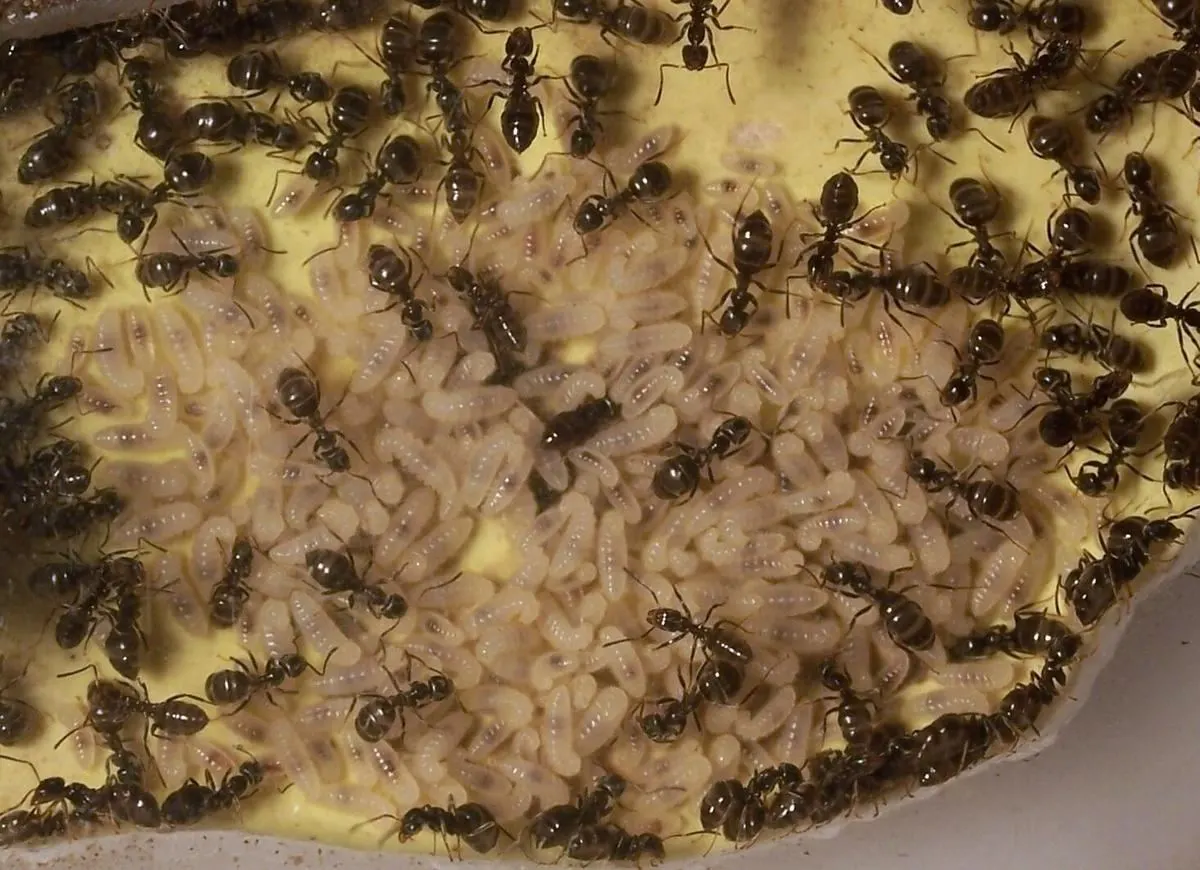
- Workers 3–5 mm, all roughly the same size, dark brown to jet black and slightly shiny.
- A single small node (bump) on the narrow waist between thorax and abdomen.
- Elbowed antennae, and a fine covering of hairs visible under a magnifying glass.
- Queens are about 9 mm, much bulkier, and shed their wings after mating.
- Winged males are smaller than queens and only appear on flying ant days.
- Workers move in clear trails between nest and food, following a scent path.
What it's often confused with
| Look-alike | How to tell them apart |
|---|---|
| Pharaoh ant | Tiny at about 2 mm and pale yellow to amber, it nests indoors in warm buildings; spraying makes colonies split and spread, so it needs specialist baiting. |
| Red ants (Myrmica) | Reddish-brown with two nodes on the waist instead of one, found in lawns and flowerbeds, and able to sting. |
| Yellow meadow ant | Pale yellow and rarely seen above ground; it builds grassy mounds on lawns and seldom comes indoors. |
| Termite (vs flying ant) | Termites have a thick straight waist, straight antennae and four wings of equal length, while flying ants have a pinched waist, elbowed antennae and larger front wings; termites are virtually absent from the UK. |
Signs of black garden ants
- Ant trails
- Lines of ants along skirting, worktops or window frames leading to sugar, jam or pet food.
- Nest openings
- Small heaps of fine soil or sand between paving slabs, on patios and along the base of walls.
- Sand indoors
- Fine sand appearing at door thresholds or along kitchen floor edges where ants are digging under the floor.
- Flying ants
- Hundreds of winged ants pouring out of one spot on a warm, humid summer day.
- Aphid farming
- Ants climbing roses and other plants to tend aphids for their sticky honeydew.
- Sinking paving
- Loose slabs and sand washed out from under paths close to large nests.
Where it lives and how it behaves
A black garden ant colony is founded by a single queen and grows to thousands of workers over several years. Nests sit in soil, under slabs, in lawns and at the foot of walls, often in sunny spots that warm up early in the year. Workers forage for sugar and protein, farm aphids for honeydew, and lay scent trails into kitchens once they find food. Activity starts in spring as temperatures rise and stops in autumn. On warm, still days in July and August, winged queens and males leave nests across a whole area at once to mate.
Health and property risks
Black garden ants do not sting and are not linked to serious disease in the way flies and cockroaches are. They can still carry dirt from outside onto worktops and into food, and a trail into a food business is a hygiene problem. Outdoors, large nests loosen the sand under paving and patios, and ants guarding aphids can make plant damage worse. Flying ant swarms are a nuisance but harmless.
What UK law says
No law protects black garden ants, and you are free to treat them yourself. Any product you use must be approved for sale in Great Britain and used exactly as the label says; that is a legal requirement, not a suggestion. Avoid spraying insecticide onto flowering plants where bees feed. Food businesses must keep ants out of food areas under food hygiene law.
Can you deal with it yourself?
This is one pest most people can deal with themselves. Put shop-bought ant gel or liquid bait where the trail is, then leave the ants alone: workers carry the bait back to the nest and feed it to the queen and larvae. It takes days, not hours, and spraying the trail at the same time kills the carriers. Seal the gap they are using once activity stops. Call us if ants return every year despite baiting, if they turn out to be pharaoh ants, or if they are in a commercial kitchen.
How Pest Perfection treats it
We identify the species first, because a pharaoh ant problem looks similar and needs a completely different approach. Then we trace the trail back to the nest and entry point, usually outside under paving or at an air brick, cracked render or door threshold. Treatment is normally a bait the colony carries back to the nest, with insecticide applied at the nest and entry points where it is safe to do so. We point out gaps to seal and anything drawing ants in, and record what was used. Ant treatment starts from £90.
Free inspection · from £90 · guaranteed for at least three months
Call 01727 400025How to prevent it
- 1Wipe worktops and sweep floors daily in spring and summer, and clean up sugary spills straight away.
- 2Store sugar, honey, jam and syrup in sealed containers.
- 3Don't leave pet food bowls down all day.
- 4Seal cracks along skirting, around door frames and at thresholds.
- 5Re-point gaps between patio slabs next to the house with a firm jointing compound rather than loose sand.
- 6Deal with aphids on plants close to the house, which feed large ant colonies.
What we see on our jobs
Hertfordshire's patios and paths are often laid on sand over chalk or clay-with-flints, ground that drains well and warms quickly: ideal for black garden ants. In spring, ants often come in along the joins of kitchen extensions and through the suspended timber floors of Victorian terraces. On flying ant days, swarms appear in gardens across St Albans, Harpenden and Welwyn at the same time.
Areas we cover: St Albans · Harpenden · Hatfield · Welwyn Garden City · Watford · all areas
Black garden ant: questions
Why do I have ants in my kitchen?
They have found food and laid a scent trail for others to follow. The nest is almost always outside. Wipe the trail with soapy water, put down bait, and seal the gap they are coming through once they stop.
What is flying ant day?
It is the day, or few days, when winged queens and males leave nests across a region to mate, usually in July or August on a warm, still day. Each swarm lasts a few hours. The ants are harmless, and the queens that survive start new nests.
Are flying ants termites?
Almost certainly not, because termites are virtually absent from the UK. Flying ants have a pinched waist, elbowed antennae and larger front wings than back wings; termites have a straight waist and four equal wings.
Do black garden ants bite or sting?
They do not sting and rarely bite people, though they can spray formic acid if handled. The red Myrmica ants found in lawns can sting, which itches for a day or so.
Does boiling water kill an ant nest?
It kills the ants it touches but rarely reaches the queen deep in the nest, so the colony recovers. Bait that the workers carry back is more effective, and it does not scald nearby plants.